How a Retired Headmistress Helped Me Shock-Proof My Son Before Secondary School — And Why I Wish I Had Known This Three Years Earlier
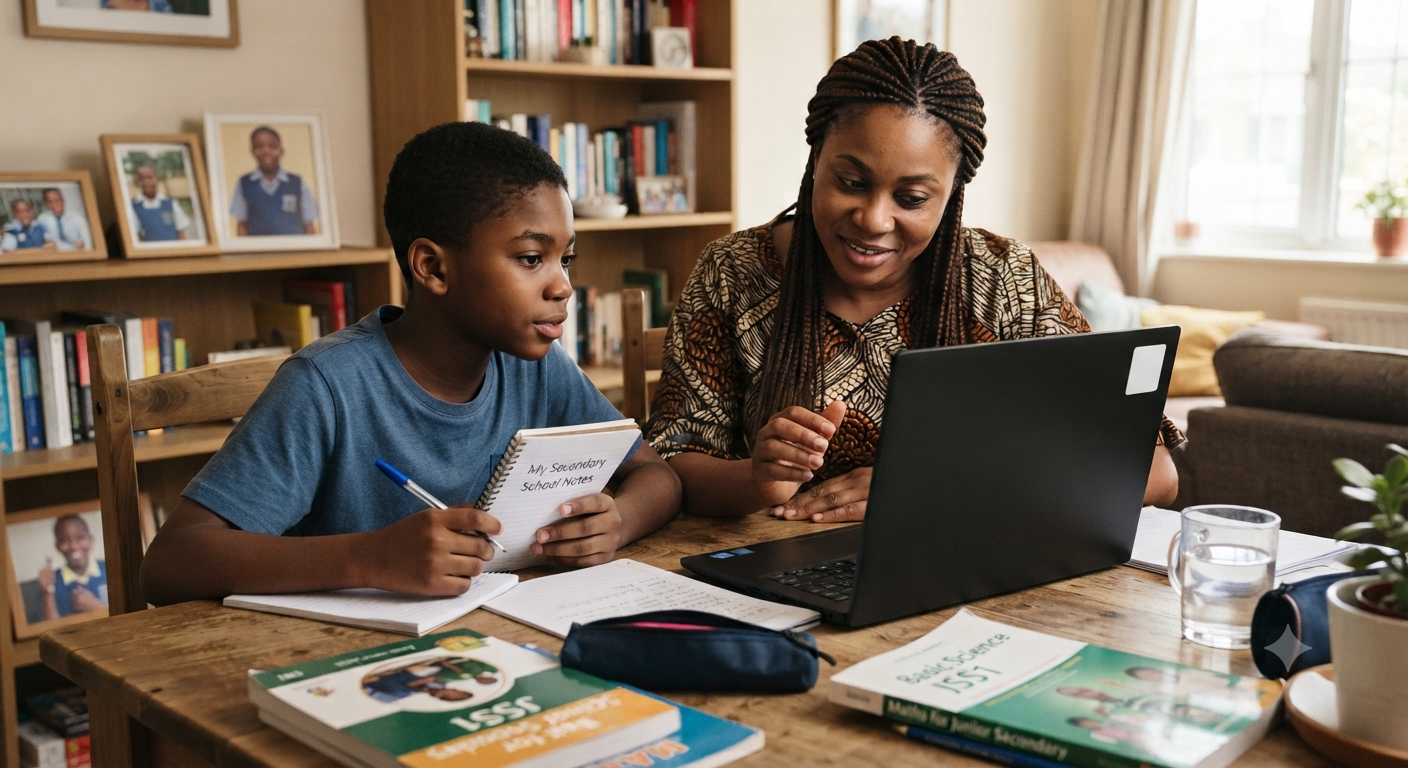
If you are a Nigerian parent whose child just got admitted into secondary school —
And somewhere underneath all the celebration, there is a quiet fear you cannot fully name —
Read every single word on this page.
Because what I am about to share with you is something nobody told me before my first son started JSS1.
Nobody told me about the homework that would pile up from five different teachers on the same day.
Nobody told me about the afternoons he would come home and stare blankly at his notes, too overwhelmed to begin.
Nobody told me about the week he came back with a test result and cried in his room for an hour. Alone. Because he had been the best student in primary school for three years running, and suddenly he was not.
Nobody warned me about the slow, silent erosion of his confidence.
I watched it happen in front of me and I did not know what it was. I thought he was just adjusting. I thought it would pass.
It did not pass.
By the middle of first term, my son was forgetting assignments. Missing deadlines. Spending two hours on homework that should have taken thirty minutes because nobody had taught him how to study independently. He would sit at the dining table, pencil in hand, and just... stare.
And I remember standing at the kitchen door watching him and thinking: what did I miss?
He passed the entrance exam. I paid the school fees. I bought the uniform, the textbooks, the school bag. I did everything I was supposed to do.
What went wrong?
The truth is, nothing went wrong with my son.
What went wrong was that I had prepared him for admission. Not for secondary school itself.
Those are two completely different things. And until a retired headmistress sat me down and made me understand this, I was going to keep watching my son struggle while thinking it was his fault.
"I know. Because I carried it too."

My name is Omotayo.
I am not a teacher. Not an educational psychologist. Not a school consultant with a certificate on the wall.
I am a mother. A mother who spent three years confused about why her brilliant son was slowly disappearing inside secondary school, and who finally found an answer in the most unexpected place.
I grew up in Ibadan. I married into a family that takes education very seriously — the kind of family where the question at every family gathering is not "how are you?" but "how is his school?" That pressure was always there, quiet and heavy.
My son, Damilola, passed his Common Entrance examination on his first attempt. His primary school gave him a sendoff. His teachers called us to say how proud they were. His grandmother said God had answered her prayers.
We celebrated. We thanked God. We moved on.
And then secondary school started. And within weeks, I began noticing things.
He stopped talking about school the way he used to. He became quieter at dinner. He started comparing himself to classmates — "Tunde understands faster than me." "Sola always finishes before everyone." Small comments. But I heard them.
By the end of first term, his grades had dropped significantly from what we all expected. Not failed. But enough of a drop that it shook his confidence badly.
I took him for extra lessons. I bought him past question books. I sat with him at night. Nothing changed fast enough. He kept struggling with the same basic problem — he had never learned how to manage himself in an environment where no single teacher was holding his hand anymore.
And I kept blaming him quietly. Wondering if he had become lazy. Wondering if I had celebrated too early.
I was looking for a solution in the wrong places. Until the day I met Mama Folake.
The Day Everything Changed for Us
It was during a naming ceremony for my cousin's baby in Abeokuta. One of those big, loud, joyful gatherings where the entire extended family comes out and nobody really knows everyone anymore.
There is always an older woman at these events. The one who sits slightly apart from the noise. The one the younger women greet with two hands. The one who does not need to raise her voice to be heard.
That was Mama Folake.
She had been a headmistress for over thirty years across several government secondary schools in Ogun State. Retired now. Quiet. Watching everything with the calm of someone who has seen every version of every family problem at least twice.
She was sitting with some of the older women during the programme. I was passing by with my son.
She stopped me. Not with words. Just a look. The kind only a woman who has spent decades watching children knows how to give.
She looked at Damilola. Then she looked at me. Then she said, very softly: "How is his school going?"
And I do not know why — maybe it was because I had been carrying it for so long — but I told her the truth. All of it. The grades. The silence at dinner. The mornings he dragged his feet. The homework battles.
She listened without interrupting. She nodded slowly. And then she said something that stopped me cold.
"You prepared him for the examination. Did you prepare him for the school?"
I had never been more ashamed in my life.
The Discovery That Changed Everything
Later that afternoon, while the celebration was still going on around us, Mama Folake found me sitting alone by the fence. She sat beside me, folded her hands in her lap, and spoke.
"You are not a bad mother. You are just a mother who did not know what she did not know."
I exhaled. I did not realise I had been holding my breath for weeks.
And then I cried. Not polite, ceremonial tears. The real kind. The kind that come from three terms of pretending everything was fine when it was not.
She paused. Let that settle.
Here is what Mama Folake helped me understand that afternoon — the thing I had never seen before.
A child's mind has a natural adjustment system. When the environment changes gradually, that system adapts quietly. But when a child moves from primary to secondary school — where everything changes at once, the teachers, the workload, the social world, the responsibility level — that system gets overwhelmed.
It is not a failure of intelligence. It is a failure of preparation. The child's habits, confidence, independence, and social skills were built for primary school. Secondary school needs completely different ones.
And because nobody prepared those new skills before resumption, the child spends the first term — sometimes the entire first year — trying to catch up. Struggling. Doubting. Withdrawing.
Shock-proofed.
That word landed somewhere deep in me and did not leave.
I thought about all the money I had spent on extra lessons after the problem started. All the sleepless nights. All the quiet frustration directed at my son when the real gap was never his intelligence — it was the preparation I had not given him before secondary school began.
It took one woman, in a quiet corner at a naming ceremony in Abeokuta, to tell me what was actually happening.
Then she told me what to do about it.
She described a method. A structured, practical way to prepare children in the four areas that secondary school actually tests — not just academically, but in terms of independence, social confidence, emotional resilience, and responsibility.
It does not require expensive tutors. It does not require special schools. It does not involve grinding or pressure or turning your home into a military academy.
It is done at home, in small daily practices, over about thirty days before resumption. Simple. Practical. Something any Nigerian parent can implement today.
The First Few Days: Nothing
I want to be honest with you.
When I got home from that naming ceremony and started implementing what Mama Folake had shared with me for my younger son Seun — who was about to start JSS1 the following year — nothing happened immediately.
Day 1. I sat down with Seun and had the kind of open conversation Mama Folake described. What excites you about secondary school? What worries you? He looked at me like I had grown a second head. He had never been asked these questions before. He gave small answers. I listened more than I spoke.
Day 2. We built a daily routine together — not one I created and handed to him, but one we made as a team. His idea: study from 4pm, short break at 5pm, dinner at 7pm. He was more committed to it because it was his.
Day 3. We set up a study corner. Not a fancy room. A table in his bedroom, cleared of distractions. A small shelf for his books. A notebook for tracking tasks. Basic. But consistent.
Day 4. I gave him his first independent study session. Thirty minutes. No reminders. No checking on him every five minutes. I stood outside the door once and almost went in. I didn't. He came out at the end and showed me what he had done. It wasn't perfect. But he had done it himself.
Four days in, I almost doubted. Is this actually doing anything?
Day 5: The First Sign
On the fifth morning, Seun woke up before I called him.
I want you to understand what this means in the context of our household.
This child had never woken up independently for school in his entire primary school career. I had been his alarm clock, his second alarm clock, and his third reminder for six years.
That morning, he was dressed before I reached his door.
Small. Maybe it sounds small. But I stood in that corridor and pressed my hand to my chest.
Something had shifted.
Day 6. Day 7. Then Something Broke Open.
By Day 8, Seun was packing his own school bag the night before without being asked.
By the end of Week 2, he had started a small notebook where he wrote down his goals for the week and crossed them off as he completed them. Nobody taught him that specific habit. He created it himself, from the general skills the method was building.
By the end of Week 3, the conversations at dinner had changed. He was asking questions about secondary school — not with dread, but with curiosity. "Mummy, what do I do if I don't understand what a teacher explains?" "What if I make friends with the wrong person?"
He was thinking ahead. Preparing himself.
And by Day 28 — two days before he completed the full preparation program — I realised I had not reminded him to study in six days.
I had forgotten to check. And that, still, is the detail that gets me.
For a mother who had spent years chasing a child to open his books, forgetting to remind him was not a small thing. It was the proof.
But the real test was yet to come.
The First Parent-Teacher Meeting
Six weeks into Seun's first term in secondary school, his class teacher called me in for the routine parent-teacher meeting.
I sat across from her prepared for what I had experienced with Damilola. The quiet, diplomatic version of "your child is struggling." The gentle suggestion to get extra lessons. The polite concern dressed in professional language.
She opened the file. Looked at his results so far. Looked at the teacher's notes.
Then she looked up at me and said: "Mrs. Omotayo, your son is one of the most self-directed children in this class. He asks questions. He organises himself. He does not wait to be told twice."
I gripped the edge of the chair.
"In thirty years of teaching, I have had very few JSS1 students who came in already prepared for secondary school. Your son is one of them. Whatever you are doing at home — continue."
I walked out of that school into the car park, sat behind the steering wheel, and cried for five minutes.
Not because it was easy to get there. Because I knew how close I came to missing it entirely.
That teacher's words confirmed what Mama Folake had told me: preparation is everything. Not intelligence alone. Not school fees alone. Preparation.
I Did Not Plan to Tell Anyone
I am a fairly private person. I did not come home from that naming ceremony planning to write about what Mama Folake told me or build anything around it.
But I told one friend. One.
Her daughter was about to start JSS1 in Lagos. She had the same quiet fear I had recognised in myself. I shared everything — the conversation with Mama Folake, the method, the daily structure, the 30-day approach.
She tried it. Six weeks later, she sent me a voice note at 11pm, crying, saying her daughter had come home and voluntarily reviewed her notes without being asked.
Then she told another woman. That woman told her sister. The sister was in Port Harcourt. The Port Harcourt woman shared it in her WhatsApp group. The group had parents in Kano, Enugu, Abuja, Benin City.
I started getting messages from people I had never met.
And every story was the same. Different family. Different city. Different child. Same problem. Same fear. And when they used the method — same result.
Same preparation. Same structure. Same results.
Why I Am Sharing This
After so many parents reached out asking me to document everything properly, I went back to Mama Folake.
I told her what had happened. That parents across Nigeria were using what she had shared with me. That families in Kano and Port Harcourt and Enugu were sending me messages about children who had entered secondary school prepared. Confident. Ready.
She laughed. The deep, satisfied laugh of a woman who has spent thirty years knowing something that nobody was listening to.
Then I asked her permission to document it all properly. To write it down so that every Nigerian parent could access it.
She was quiet for a moment. Then she said:
So I did.

Everything Mama Folake taught me — every practical insight from thirty years inside secondary school classrooms — documented, verified, written in plain everyday language, so you can begin preparing your child tonight.
- The Academic Shock-Proof Method™ explained in full — the four types of Academic Shock, how to spot each one, and how to prevent all four before school begins. (Pages 8–22)
- The complete 30-Day Academic Shock-Proof Plan™ — a daily preparation roadmap broken into four focused weeks, with specific activities for each day. (Pages 46–68)
- The Learning Stamina Builder — trains your child's brain to concentrate for longer periods before school resumes. (Pages 26–29)
- The Responsibility Gap Exercises — practical daily activities that shift ownership from parent to child gradually. (Pages 32–38)
- The Friendship Filter and Peer Pressure Scripts — what to teach your child about recognising healthy friendships and how to say no wisely. (Pages 40–44)
- The Confidence Protection Blueprint — how to protect your child's self-belief during the hardest part of the transition. (Pages 46–52)
- The Secondary School Readiness Assessment™ — rate your child across all four readiness areas before the first day. (Pages 70–74)
- The Parent's Weekly First-Term Check-In Guide — exactly what questions to ask each week so you catch problems early. (Pages 76–78)
You do not need to travel anywhere. You do not need to hire a consultant. Everything in this guide can be implemented at home, starting today. Total cost of materials: zero naira.
Compare That to What You May Already Be Spending
How Much Does This Guide Cost?
Let me be transparent about what it took to put this together properly.
- Professional writing and documentation — ₦35,000
- Research, verification, and educational review — ₦18,000
- Practical testing with real Nigerian families across six states — ₦12,000
- Design, layout, and formatting — ₦14,000
- Website setup, delivery system, and hosting — ₦9,500
- Revisions across three full drafts — ₦8,000
Total investment to create this guide: over ₦96,500.
I am not going to charge you ₦96,500. Not ₦50,000. Not even ₦20,000.
A fair price, given what this guide can save you in extra lesson fees and remedial classes, would be ₦9,500. But because I want this to reach as many Nigerian parents as possible before the next resumption —
Once You Click That Button, Here Is What Happens
- You are taken to a secure payment page — pay by card, bank transfer, or USSD. Takes less than two minutes.
- Your payment is confirmed automatically — no waiting, no sending screenshots to anyone.
- Your guide is delivered instantly to your WhatsApp and email — within 60 to 90 seconds of payment.
It is me, Omotayo. As long as your payment is confirmed, your access is 100% guaranteed.
What Happens in the First 7–14 Days
Real conversations. Real parents. Real results.
WAIT — I Have Something Special For You...
If you are one of the first 75 parents to get the guide today, you will also receive this bonus at absolutely no extra cost:
A quick-read companion checklist covering 25 practical things most parents never think to teach their children before JSS1 begins. Print it and go through it with your child together the week before resumption.
Everything You Are Getting Today

- Passed the Exam... But Is Your Child Really Ready?™ — Complete Academic Shock-Proof Method™ guide (78 pages)
₦9,500 - BONUS: 25 Things Every Secondary School Child Should Know Before Resumption
₦3,500
More Parents. More Cities. Same Results.
I bought this for my nephew who is in my care. This guide gave me a structure I could actually follow. Week by week. Day by day. He is in JSS1 now and his report has been good. As a single guardian I am grateful beyond words.
Chapter 4 on Responsibility Shock changed the way I parent. I stopped packing my daughter's bag for her. I gave her the checklist instead. She forgot one item the first day and was upset. I did not rescue her. She never forgot that item again. One lesson. Permanent habit. The guide is gold.
I shared this with my daughter's school PTA group. Several families are now doing the 30-day plan together and comparing notes. The guide has practically started a community in our school. Thank you Omotayo for being brave enough to share this.
My wife and I both read this together. This guide gave us a shared language and a shared plan. We stopped pulling in different directions. Our son felt the unity and I think that alone calmed him down about starting secondary school. The guide works on the parents too. That was something I did not expect.
My son used to say "I'm not smart" whenever he made a mistake. After the confidence chapter he now says "I haven't figured this out yet." YET. That one word. That shift. I cannot put a price on what that means for his future.
Right Now, You Have Two Choices
Choice 1: Do Nothing
- Your child walks into secondary school exactly as they are today — unprepared for the real demands waiting.
- The homework pile builds. The confidence quietly erodes. The Sunday evening dread becomes a weekly fixture.
- You spend the first term watching and wondering — is this just adjustment, or is something wrong?
- You begin paying for extra lessons after the problems start, trying to fix what preparation could have prevented.
- Your brilliant child spends a year catching up instead of building momentum from Day One.
Choice 2: Prepare Your Child Now
- You begin the 30-Day Academic Shock-Proof Plan™ this week — before resumption, before the problems start.
- Your child builds independence, confidence, and responsibility in small daily steps that feel natural.
- They walk through those school gates on the first day ready — not just admitted.
- Their class teacher notices the difference. You notice the difference. Your child feels the difference.
- You watch them build momentum from the very first week — and you know you gave them that.
One Last Thing...
Picture yourself one month from today.
Will you be watching your child walk out the door in the morning with confidence — bag packed the night before, routine in place, ready for whatever the day brings?
Will you be sitting at a parent-teacher meeting hearing words like "self-directed" and "well-prepared" and "one of our stronger students this term"?
Will you be the parent who gave their child not just admission — but genuine readiness?
Now picture yourself one month from today if you close this page.
The worry is still there. The Sunday evenings are still hard. The homework battles are still exhausting. The confidence is still slipping — quietly, slowly, in ways your child does not have the words to describe.
The difference between those two versions of you is a decision you make in the next sixty seconds.
If you have read this far and you are still hesitating —
Is it that you do not believe the method works? You have read what dozens of Nigerian parents across six states are saying. The evidence is here.
Or is it that somewhere, quietly, you do not fully believe your child deserves this level of intentional preparation?
You spent money on the school fees. You spent money on the uniform. You spent money on the textbooks.
If you cannot invest ₦5,500 in the preparation that actually determines how your child experiences all of that — what does that say about where the real priority is?
Stop hesitating. Choose your child. Choose preparation. Choose now.
P.S. — The preparation your child receives in these 30 days before resumption can change the entire trajectory of their secondary school experience. The investment is ₦5,500. The cost of not preparing could be years of struggle, lost confidence, and potential that never fully shows itself.
P.P.S. — This discounted price of ₦5,500 is available for the first 75 parents only. Once those slots are filled, the price returns to ₦9,500. If you are reading this, the offer is still open — but I cannot tell you for how long.
P.P.P.S. — Every day you wait is another day your child moves closer to resumption without the preparation they need. Academic Shock does not wait for you to be ready. But you can make sure your child is.
Frequently Asked Questions
How will the guide be delivered to me after payment?
Immediately after your payment is confirmed — usually within 60 to 90 seconds — the guide is delivered directly to your WhatsApp number and your email address. No waiting. No sending proof of payment to anyone. Just pay and receive instantly.
Are special materials needed to implement this method?
Everything in this guide requires nothing you need to buy from a special store. The entire Academic Shock-Proof Method™ is built around conversations, daily habits, structured activities, and intentional preparation — things you do at home with your child. Total additional cost to implement: zero naira.
My child has already started secondary school and is struggling. Is it too late?
It is not too late. While the guide is designed for preparation before resumption, the four pillars can be built at any point during the secondary school journey. Many parents have used this guide mid-term with struggling children and seen meaningful improvement within two to three weeks.
My partner thinks children just naturally adapt. Will this guide help me explain why preparation matters?
Yes. Chapters 1 and 2 specifically address why even intelligent children experience Academic Shock, and why natural adaptation alone often takes an entire year of struggling before it happens. Many skeptical spouses have become the most committed implementers of the 30-Day Plan after reading it themselves.
How quickly will I see results in my child?
Most parents report noticing small but significant shifts within the first 5 to 7 days — a child waking up independently, packing their bag without being reminded, or showing more curiosity than dread about secondary school. Deeper changes in confidence and independence typically become visible by the end of Week 2.
How is this different from the general parenting books I have already read?
Most parenting books are written for Western contexts and offer no Nigeria-specific, secondary-school-specific daily action plan. This guide was built from thirty years of experience inside Nigerian government secondary school classrooms. It names the four specific shocks Nigerian children face, explains exactly why they happen, and gives you a day-by-day plan you can start tonight.
Did this article help you? Share it with another Nigerian parent before their child starts secondary school.
One-time payment | Instant WhatsApp & Email Delivery | Secure & Private
© 2026 Parent Guide Blog | All Rights Reserved
Results mentioned are real but individual results may vary based on implementation.
Privacy Policy | Terms of Use | Contact
What Other Nigerian Parents Are Saying
Omotayo I cannot thank you enough. My son Chukwuemeka started JSS1 this September and I was so worried. After reading your post I tried the 30-day preparation with him. By the third week this boy was packing his bag the night before without me saying anything. His form teacher called me last week to say he is one of the most organised children in his set. Me wey dey follow am everywhere before. God bless you.
I was skeptical honestly. My daughter Zainab is brilliant but she had been in a very small private primary school where the teachers practically held her hand through everything. I was terrified about the big government secondary school she got into. We did the preparation exactly as described. The confidence alone that this girl has now — wallahi it is different. She walked into that school on the first day and did not look back once. I stood at the gate and cried by myself.
My husband thought I was wasting time doing "preparation activities" with our daughter when she should just be reading her new textbooks. I did it anyway. First term result just came out. She came 4th in her class. Last year when her brother started secondary school without this kind of preparation he came 19th first term. Same school. Same family. The difference is the preparation. My husband has not said anything but I see him smiling.
The part about confidence shock — ehn. That section alone opened my eyes. My first daughter lost so much of herself in JSS1 because she had always been the best and suddenly she was not. We never knew what to call it. Now my second daughter is starting and I know exactly what to watch for and how to protect her confidence before it even gets shaken. This information is priceless. Absolutely priceless.
My son used to cry every Sunday evening because he was afraid of the week ahead. I thought it was just normal school stress. After the preparation method especially the emotional resilience part — he stopped. Just stopped. Last Sunday he reminded me that he had assignments to finish before Monday. He reminded me. I sat down and said a prayer right there in the kitchen.
Share Your Experience